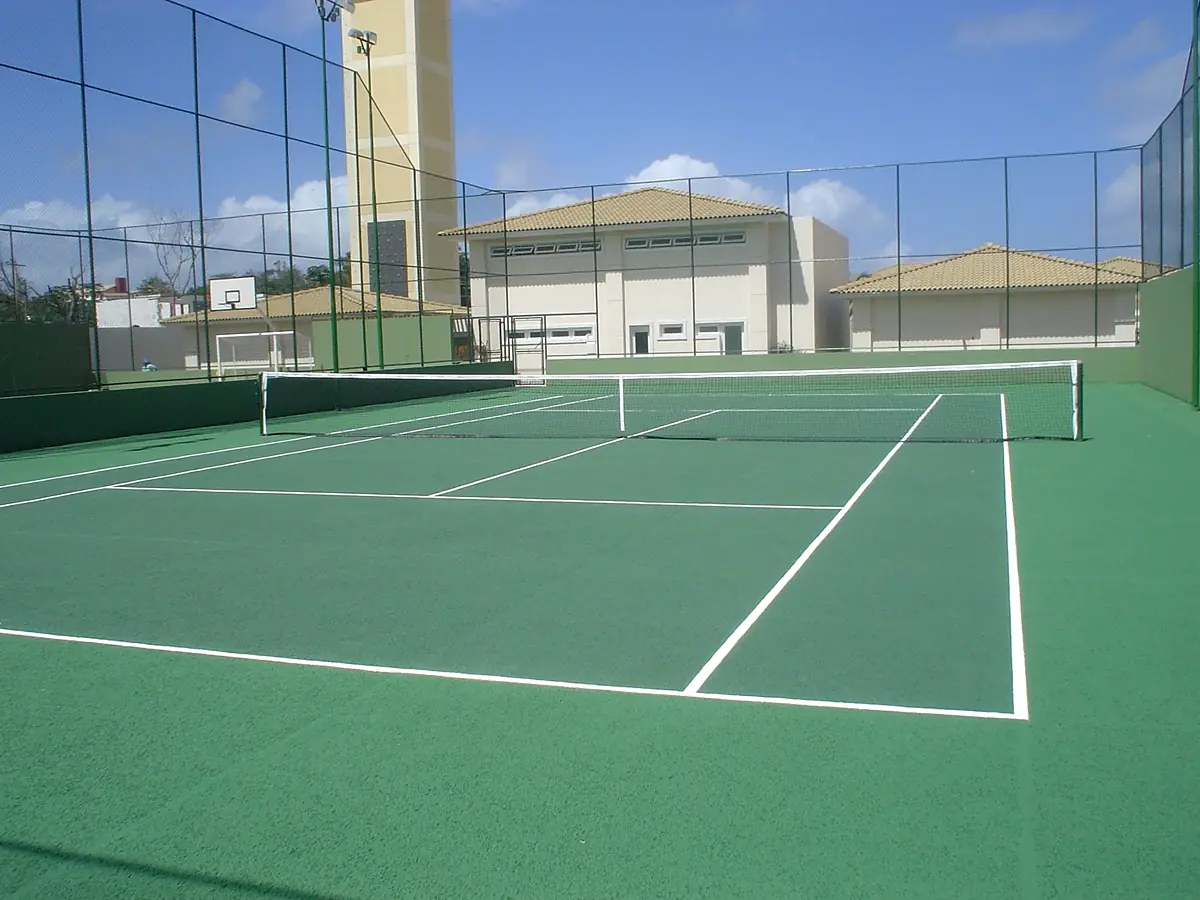
How a court is meant to drain
A hard court is not flat. It is built as a single tilted plane, commonly with a fall of about 1 in per 10 ft, which works out to roughly 0.83% to 1%. The plane runs side to side, end to end or corner to corner, depending on the site, and water sheets across the surface to the low edge. Tennis courts are normally not crowned like a road, because a crown changes the bounce near the center.
Across the length of a 120 ft playing area, a 1% fall puts the high end about 14 in above the low end. Across a 60 ft width, the difference is about 7 in. A depression a quarter of an inch deep is tiny against those figures, but it is enough to hold water for hours, because the water inside it has no slope left to follow.
Common causes of birdbaths
Most ponding comes from one of four causes, and older courts often show more than one.
A fifth, simpler cause sits outside the court: grass, soil or mulch along the edge that has grown higher than the pavement and dams the water in. That one is fixed by regrading the strip along the edge, not with patch material.
- Base settlement: the aggregate base or subgrade compacts or softens under one area, often where water has entered through cracks for years. The asphalt follows it down and forms a bowl.
- Insufficient slope: the court was paved with too little fall, or with a fall that varies, so water stalls on flat areas. This tends to show as wide, shallow ponds rather than distinct bowls.
- Coating build-up: after many resurfacings, resurfacer and color can build unevenly, especially near the edges and the fence line, and form a lip that holds water back on the court.
- Root heave: tree roots lift the pavement into a ridge, and water ponds on the uphill side of it. Cracks along the ridge usually follow within a season or two.
The flood test, step by step
The standard way to find ponding is to make it happen on purpose. The test needs a hose, chalk and an hour of sun, and a manager or board member can watch it done.
Puddles shallower than the threshold usually dry quickly and are not worth a patch. The result of the test is a map: which areas hold water, how large they are and how deep. That map decides the repair method and the quantities in the written scope, and it is the same map used to accept the work afterwards.
- Flood the court with a hose, or wait for a heavy rain, until the whole surface is wet and water runs off the low edge.
- Let it drain in sun for about an hour. Shade, cool air and high humidity slow evaporation, so note the conditions.
- Walk the court and outline every remaining puddle with chalk or a crayon.
- Check depth: a common threshold is about 1/16 in (1.6 mm). A quick field check is whether the water covers a nickel laid flat in the deepest point.
- Measure the size of each marked area and its deepest point, and photograph it with the chalk outline visible.
- After repairs cure, flood again to confirm the areas now drain.
Ponding reference figures
- Typical court slope
- About 1 in per 10 ft, 0.83% to 1%
- Slope direction
- One plane: side to side, end to end or corner to corner
- Flood test wait
- About 1 hour in sun after flooding
- Common threshold
- Water deeper than about 1/16 in (1.6 mm), the nickel check
- Local, shallow ponding
- Acrylic patch binder leveling, rechecked with water
- Wide or deep ponding
- Slope correction, base repair or reconstruction
Typical industry figures. The flood test and survey set the scope for your court.
Why ponding costs more in Florida
In much of Florida, summer brings an afternoon storm on many days. A court that holds water for two hours after each storm loses a large share of its playable afternoons, and the same spots stay wet for most of the season. What happens in those spots is predictable:
- Algae and mildew grow in the wet areas and turn them slick and green-black.
- Minerals in the water stay behind as it evaporates, leaving rings and stains in the color.
- Wet acrylic is slippery, and a player who steps into a birdbath mid-rally gets no warning.
- Standing water softens and breaks down the acrylic in the same spots, so color wears through there first.
- Water that finds a crack inside a birdbath feeds the base underneath, which can deepen the settlement that formed the birdbath.
Fix one: leveling with patch binder
Most birdbaths on a sound court are corrected with an acrylic patch binder mixed with sand, and in many systems portland cement, spread into the low area and struck off with a straightedge to the surrounding grade. The edges are feathered so no ridge is left, and deeper areas are filled in several thin passes, each allowed to dry, rather than one thick pass that can shrink and crack.
After the patch cures, the area is flooded again. If water still stands, it gets another pass. Only then do the resurfacer and color coats go on, because acrylic color is far too thin to fill a low area by itself. A bid that plans to correct ponding with extra color coats is not correcting it.
This method suits low areas that are local and fairly shallow. Manufacturers limit how deep patch mix can go per pass and in total, so a deep bowl, or one over soft base, needs one of the approaches below.
Fix two: slope correction and base repair
When ponding covers wide areas because the slope itself is too flat, local patches do not help: there is nowhere for the water to go. The options are a leveling course or overlay over the existing pavement, laid to a measured fall, or reconstruction. A level or laser survey taken on a grid across the court shows how far the existing plane is from a usable slope before either option is priced.
When the cause is settlement under a defined area, the durable repair is to cut out the asphalt, remove the soft material, recompact and rebuild the base, pave the patch and level it into the surrounding surface. When the cause is root heave, the root is cut back, a root barrier is usually set along the court edge by the property's landscaper or arborist, and the ridge is removed and patched. Leveling over a root ridge or a soft base only buys time.
Coating build-up and edge lips
On courts that have been resurfaced many times, the problem is sometimes on top rather than underneath. Each cycle adds resurfacer and color, and crews tend to apply more along the edges where the squeegee turns. Over decades this can leave a raised band along one side that holds water back on the playing area.
The fix is to grind or remove the built-up band along the low edge, so water can leave the court again, then level and recoat. It is worth checking for before paying for patch leveling inside the court, because filling the birdbaths without opening the edge only moves the water.
When ponding means resurfacing is not enough
Ponding is a symptom. Some patterns point to a court whose base or plane has reached the end of its life, and another resurfacing will not change that. In those cases the honest scope says so in writing. Our Florida offer is restoration and maintenance of existing courts, so where a court needs a new base, we tell you that directly before any coating is priced.
- Birdbaths that return within a season or two of correct leveling.
- Ponding spread across a large share of the court, not in a few spots.
- Birdbaths that line up with wide or stepped cracks.
- Soft or spongy pavement underfoot in the ponding areas.
- A survey showing a plane far too flat, or a fall that reverses direction across the court.