
FAQ
Questions owners and managers ask about their courts
The answers below are grouped by service, surface, sport, segment, guide and company. A question that depends on your court is answered by the free on-site assessment.
When the answer depends on your court
Cost, closure time and the right repair all depend on the condition of the base, the cracks and the water on the surface. The free assessment measures those on site and ends in a written, itemized scope. For anything else, write to arenas.courts@gmail.com or use the contact page.
Services
How often should a tennis court be resurfaced in Florida?
Most acrylic courts need it every 4 to 8 years. Heavy use, full sun and poor drainage push it toward the short end. Washing every two to three months and fixing cracks early push it toward the long end.
How long does a resurfacing take?
For one court, usually one to two weeks of site work, depending on the repairs and the weather. Each coat must cure dry before the next, so rain days add to the schedule.
Can you add pickleball lines during the resurfacing?
Yes. It is the best moment to do it, because the lines go on fresh color. We lay out the courts in your chosen colors and can add nets and posts.
What does a resurfacing cost?
Typical US industry ranges for an acrylic resurfacing of one tennis court run roughly $5,000 to $12,000. Crack and low-spot repair can move that figure a lot. Your price comes from the on-site assessment.
Will resurfacing fix cracks for good?
Resurfacing seals and fills cracks, but cracks caused by base movement can return. We tell you which cracks are cosmetic and which are structural before you approve the scope.
Can tennis court cracks be repaired permanently?
Surface cracks, yes, when they are filled properly and sealed. Cracks caused by a moving base can return. A bridging system slows that a great deal, and only rebuilding the base removes the cause.
Why does water stay on my court after rain?
The pavement has settled in spots or was not built to an even slope. A hard court should drain on a slight cross slope, about 1%. Low spots break that plane and hold water.
Do the repairs show after the work?
Patched areas are covered with resurfacer and color. If only the repaired areas are recoated, there can be a slight color difference until the whole court is resurfaced.
Should I repair cracks now or wait for a full resurfacing?
Repair early. A small crack lets water into the base, and every storm makes it wider. Early repair costs less and protects the pavement until the next resurfacing.
How many pickleball courts fit on one tennis court?
Two, or up to four when the existing fenced area allows. The full fenced area, not just the tennis lines, decides the count.
Can we keep tennis and add pickleball?
Yes, with blended lines. Pickleball lines go on in a different color and players use portable nets. Tennis players see more lines, which most get used to quickly.
What does a conversion cost?
Typical US industry ranges for lines only on an existing court run roughly $1,500 to $6,000. Nets, fixed posts, windscreens and resurfacing add to that. Your price comes from the on-site assessment.
Do we need to resurface first?
Only if the surface is worn, cracked or holds water. If it is, resurfacing first is worth it, because the new lines then bond to fresh color and last as long as the surface.
What about noise for nearby homes?
Pickleball is louder than tennis. We look at distance to homes during the assessment, and the board can consider court placement and windscreens on the fence.
How often should a hard court be cleaned?
Every two to three months in Florida, more often under trees or in shade. Dirt, leaves and mildew hold moisture against the acrylic and shorten its life.
Does a plan replace resurfacing?
No. It delays it. Every acrylic court will need resurfacing. A plan helps the surface reach the long end of its 4 to 8 year cycle and lets you budget for it.
Can you train our staff to care for a clay court?
Yes. Clay needs daily watering, rolling and brushing, which is best done by people on site. We show your crew the routine and handle the periodic work.
Are repairs included in the plan?
Small repairs listed in the plan are included. Larger work, such as crack repair across the court or resurfacing, is quoted separately and done only with your approval.
Ranges are typical industry figures for planning, not a quote. Your court’s scope and price come from the on-site assessment.
Surfaces
How long does a hard court surface last?
The acrylic system usually needs resurfacing every 4 to 8 years, depending on use, sun and drainage. The pavement underneath lasts much longer when cracks are repaired early.
Is a hard court hard on the body?
It is firmer than clay, because the foot does not slide. Cushioned acrylic systems add rubber layers under the color to soften the feel.
Asphalt or post-tension concrete?
Asphalt costs less up front and needs crack repair over time. Post-tension concrete costs more and resists cracking well. The site and budget decide.
What is TennisFast?
A porous all-weather concrete court we build in Brazil. Water drains through the surface, so it does not pond after rain.
What colors can a hard court be?
Acrylic color comes in a wide range. Blue inside the lines with a green surround is common because the yellow ball reads well against it. Pickleball lines are often painted in a contrasting color.
Is clay a good choice for an HOA?
Only if someone will water, roll and brush it every day. Without that, clay hardens, loses its lines and becomes uneven. For unattended courts, a hard court is the safer choice.
What is the difference between green clay and red clay?
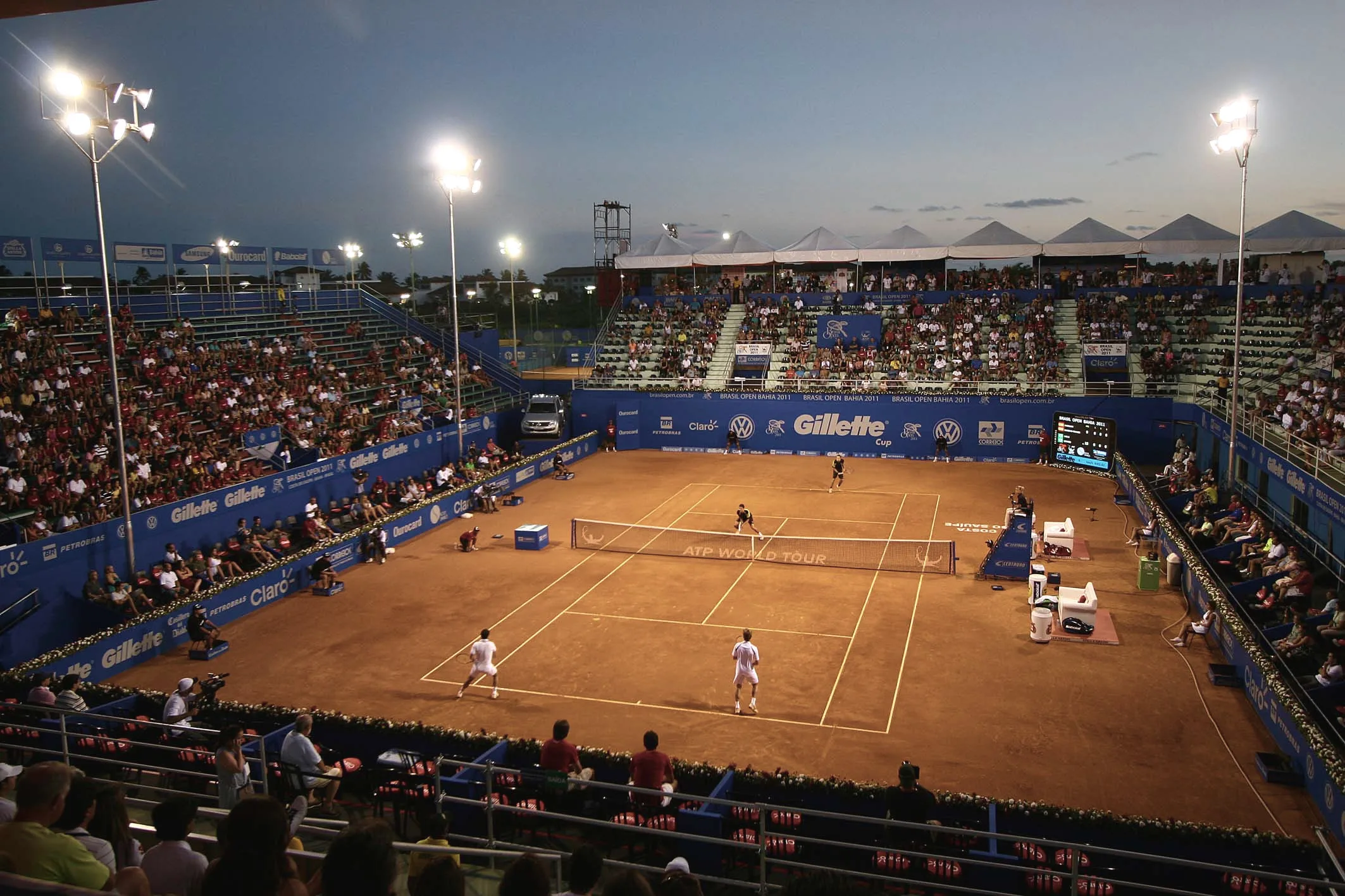
In the US, clay courts are mostly fast-dry green clay. Red clay is common in Europe and South America, and it is what we built for the ATP Brasil Open. Both are granular surfaces that slide underfoot.
Can a clay court be restored?
Yes. Leveling, new clay as top-dressing, rolling and new lines bring a worn clay court back, as long as the base drains.
Does clay drain after rain?
A well-built clay court drains through its base. Play resumes once the surface firms up, which depends on how much rain fell.
What does the daily routine involve?
Before play, water the court to the right moisture. After play, brush the surface and sweep the lines. Roll it on a regular schedule so it stays firm. Your staff does this; we train them at handover.
Synthetic or natural turf for a community field?
Synthetic, in most cases. It takes daily use and rain without a recovery window. Natural turf plays beautifully but needs irrigation, mowing and rest.
Does synthetic turf need maintenance?
Yes, less than grass but not none. Regular brushing, infill top-up in high-wear areas and seam checks keep it even and safe.
Can you repair fencing and overhead netting?
Yes. We repair fence fabric, posts, gates and overhead netting around an existing field. New fencing installation is not part of our Florida offer yet.
Can a field share space with a tennis court?
Yes. At Reserva Sauípe, in Brazil, a soccer field sits beside a tennis court behind shared fencing. On multi-sport courts, our retractable goal clears the court for tennis.
Do you work on small-sided fields?
Yes. Small-sided fields fit communities and resorts well, and they need the same care as a full-size field at a smaller scale. In Florida we restore and maintain existing fields: grooming, infill, seams, lines and fence repair.
How often should a gym floor be refinished?
It depends on use. A screen-and-recoat before the finish wears through keeps the floor protected. A full sanding is needed when the wood itself is exposed or damaged.
Can you change the lines on our gym floor?
Yes. Lines are repainted during refinishing, so it is the moment to add or change markings for basketball, volleyball or futsal.
How long does the floor stay closed?
A few days to more than a week, depending on sanding, number of coats and curing time. The written scope gives the schedule.
Do you work on squash courts?
Yes. We sand and refinish squash floors and repaint the regulation lines.
How do we keep the floor in good shape between refinishes?
Dust-mop daily, damp-clean with a cleaner suited to the finish, use mats at the entrances and keep street shoes off the court. Avoid wet mopping, which lets water into the joints.
Sports
How long is a tennis court closed for resurfacing?
One court usually takes one to two weeks of site work, depending on repairs and weather. Each acrylic coat must cure dry before the next, so Florida afternoon storms add days. A clay renovation commonly closes a court for a few days.
Can the club stay open while you work?
Yes, when there is more than one court. We phase the work court by court, fence off the work area and keep material and equipment away from courts in play.
What does it cost to put off a resurfacing?
Open cracks let water into the base. A court that would have needed a typical resurfacing, roughly $5,000 to $12,000 in the US, can turn into a patching and leveling job that costs more, or a base rebuild.
Can you take over maintenance of our clay courts?
We train your staff on the daily routine and handle the periodic work: spring renovation, leveling, top dressing and line tapes. Daily brushing and watering are best done by people on site.
Are you licensed in Florida?
Our Florida contractor license is pending. Ask us for the current status before you sign.
How long are the courts closed?
Re-striping alone usually takes a few days including cure time. A full resurfacing with repairs commonly takes one to two weeks per group of courts, plus weather days in the Florida summer.
Can some courts stay open during the work?
Yes, where the layout allows. We phase the work by court or by fenced bay and keep material and traffic away from the courts in play.
How often do pickleball courts need resurfacing?
On the same 4 to 8 year cycle as other acrylic courts, but heavy daily play often puts them at the short end, because the kitchen band wears faster than the rest of the court.
What happens if we only repaint the lines?
New lines on worn or cracked color last a short time, and they hide wear from the board. If the kitchen band is polished smooth, slips are the real cost.
Do you convert tennis courts to pickleball?
Yes. That work, layouts and court counts included, is covered on our pickleball conversion page and in the conversion guide.
How long is a padel court closed for maintenance?
A brushing and sand top-up usually takes part of a day. Seam and line repairs need glue cure time, commonly a day or two. Turf replacement on the existing base takes longer and depends on the weather.
How often should the turf be brushed?
Busy courts commonly need it weekly, and after every storm. Sand depth should be checked at least monthly, because it moves faster than it looks.
What does it cost to neglect the infill?
Without enough sand, the fibers take the wear directly and the turf wears through years early. Replacing the turf costs far more than keeping the infill topped up.
Can one court be serviced while the others stay open?
Yes. Maintenance is usually done court by court, with sand and equipment kept outside the courts in play.
Have you built padel courts?
No. Our completed work is in Brazil, in tennis, multi-sport and turf. Arenas is confirming its padel offer; ask us and we will tell you what we can take on today.
How long is an outdoor court closed?
A resurfacing with lines usually takes one to two weeks of site work, depending on repairs and weather. Backboard and rim replacement on sound posts commonly takes a day.
How long before a refinished gym floor can be used?
It depends on the finish. After a screen and recoat, light use is commonly possible within a few days; a full sand and refinish needs longer cure before games. The scope gives the dates.
Can the school or club stay open during the work?
Yes. Outdoor courts are fenced off during the work. Gym floors are usually done during breaks, because the finish needs ventilation and no traffic while it cures.
What happens if a gym floor is not recoated on time?
Once the finish wears through, dirt and moisture reach the wood. A floor that needed a screen and recoat then needs a full sand and refinish, which removes wood and costs several times more.
Do you install new basketball posts?
Our Florida offer is restoration and maintenance of existing courts. We replace backboards, rims and nets on existing posts that are sound.
How long is the court closed for a sand top-up?
A top-up and leveling usually takes one or two days, depending on access for the sand delivery. Replacing sand or fixing a clogged drainage layer takes longer.
How often does the sand need attention?
Raking and leveling are routine, often weekly on busy courts. Depth should be checked every few months. Top-ups are commonly needed once or twice a year, more after heavy storms.
What does it cost to neglect the sand?
Thin or compacted sand raises the risk of injuries on landing. Contamination that reaches the drainage layer turns a top-up into a sand replacement, which costs much more.
Can the club stay open during sand work?
Yes, where there is more than one court. The work is usually done court by court, with the sand delivery and equipment kept away from courts in play.
Have you built beach tennis courts?
No. Arenas is confirming its beach tennis offer; ask us and we will tell you what we can take on today. Our confirmed Florida offer is restoration and maintenance of existing tennis, pickleball and basketball courts.
Ranges are typical industry figures for planning, not a quote. Your court's scope and price come from the on-site assessment.
Who we serve
Can you present the scope to our board?
Yes. The written scope is designed to be forwarded, and we can join a board meeting in person or by video to answer questions about it.
How long will the courts be closed?
It depends on the repairs and the weather. A typical resurfacing closes a court for several days to a few weeks. The scope gives a closure window before you approve it.
Can you help with our reserve study numbers?
We can itemize the court by component with a condition note for each, which your reserve specialist can use. We do not prepare the reserve study itself.
Do you work with management companies?
Yes. We work through the property manager as the point of contact and copy the board on scopes and schedule notices when asked.
Does each association contract separately?
Usually yes, because each board controls its own budget and approves its own work. The scope format, the reporting and the point of contact stay the same across the portfolio.
How often should the portfolio be inspected?
Once a year as a documented round, plus a short check after storm season for courts with known drainage or crack problems. Courts rated poor can move to a shorter cycle.
Can you work with our reserve specialists?
Yes. We send condition data per component in a form the specialist can use. We do not prepare the reserve study itself.
Do you build new courts for communities?
Our Florida offer is restoration and maintenance of existing courts: resurfacing, crack and ponding repair, pickleball lines, nets, posts and windscreens, and maintenance plans.
Have you built courts in the United States?
Not yet. Our track record is in Brazil since 2003, including the ATP Brasil Open center court. The US company, Arenas Sports Buildings LLC in St. Johns, FL, is new, and we say so plainly.
Do you build Har-Tru green clay courts?
Not in Florida. Our clay courts so far are red clay in Brazil. In Florida we restore and maintain existing courts, green clay included: we scope the materials and method for that system and tell you exactly which parts we have done before.
Can you work while the club stays open?
Yes, on multi-court jobs we phase the work so some courts stay in play, with staging and access kept away from members.
Do you work as a subcontractor on larger projects?
Yes. On a larger club renovation we can take the court restoration package under a general contractor. Our Florida offer is restoration and maintenance of existing courts.
What does a court assessment include?
A visit to the club, measurements, photos and condition notes for each court, followed by a written scope and estimate. The assessment is free.
Can guests keep playing while you work?
Yes, on properties with more than one court. We phase the work so at least one court stays open, fenced off from the work zone. A single-court property loses the court for the full closure window, so we place it in the lowest-occupancy weeks.
How long is a court closed for resurfacing?
The written scope gives the closure window for your courts; one to two weeks of site work per court is a typical range, depending on repairs and weather. Each acrylic coat must dry before the next, so Florida afternoon storms add days. The phase plan gives a date for each court.
Do you maintain padel and beach tennis courts?
Arenas is confirming its padel and beach tennis offer. Ask us and we will tell you what we can take on today. Our confirmed Florida offer is restoration and maintenance of existing tennis, pickleball and multi-sport hard courts.
Have you worked for hotels in the United States?
Not yet. Our resort work is in Brazil, for properties including Iberostar, Reserva Sauípe, Tivoli, Vila Galé and Grand Palladium. The US company is new, and we say so plainly.
Can the work be done during a school break?
Yes, and that is how we prefer it. Tell us the break dates at the assessment and the scope will show whether the work fits inside them.
How long does a gym floor refinish take?
Sanding, lines and finish coats take several days of work, plus cure time before play. The exact window depends on the floor size and the finish chosen, and the scope states it.
Do you replace basketball backboards and goals?
Yes, on existing courts. We replace backboards, rims, goals, nets and posts where the footings are sound. New posts on new footings are not part of our Florida offer yet.
Can you work with our procurement process?
Yes. The written scope itemizes each task with quantities, which makes it easier to compare against other bids and to match a bid form.
Can you convert a school court for pickleball?
Yes. A tennis court footprint typically fits two pickleball courts painted on the existing surface. Lines can be added alongside existing tennis or basketball lines in a separate color.
Guides
How long does resurfacing take?
A single court in fair condition usually takes several working days, plus curing time. Rain delays acrylic work, so in Florida summers schedules leave margin for afternoon storms.
Can we resurface only the worn areas?
Spot repairs are possible, but new coating rarely matches faded color. Most owners resurface the full playing area so color and texture are even.
Is the assessment free?
Yes. We inspect the court on site, measure cracks and ponding, and send a written scope and estimate.
Why do bids for the same court differ so much?
Usually because the scopes differ: number of coats, crack repair method and whether ponding is corrected. Compare written scopes line by line.
Does resurfacing fix cracks permanently?
Crack filling seals and hides cracks, but active cracks in asphalt can reopen as the base moves. Wider or recurring cracks may need a reinforced repair system.
Our court is five years old and looks fine. Should we resurface?
Not necessarily. Have it inspected. If texture, color and drainage are good and cracks are sealed, you may have several more years.
Does resurfacing more often make the court last longer?
Resurfacing on time protects the base. Resurfacing too often adds layers without benefit. The trigger should be measured wear, not a calendar alone.
Can cracks be repaired without resurfacing?
Yes. Cracks can be sealed between resurfacings, though the repair will show in color until the next full color coat.
What is the best season to resurface in Florida?
Drier months are easier for acrylic work. Summer work is possible with early starts and room in the schedule for afternoon storms.
Who should keep the inspection records?
The board or manager should hold them, with photos and dates. Records travel with the property when management changes and support the reserve study.
Is clay easier on the body?
Generally yes. The sliding surface and slower ball reduce impact on joints, which is why many senior players prefer clay.
Can a hard court be converted to clay?
It is possible, but it is a reconstruction: clay needs its own base, drainage and often irrigation. It is not a coating change.
Which surface is cheaper to own?
It depends on staffing and use. Clay has steady daily labor and water costs; hard courts have periodic resurfacing. Compare both over ten years.
Have you built Har-Tru courts in Florida?
No. Our clay work is in Brazil, including the ATP Brasil Open center court. In Florida we focus on hard court resurfacing, repair and conversions.
Does a hard court get too hot in Florida summers?
Dark colors absorb more heat. Lighter acrylic colors, shade near the benches and early or late play hours make a real difference.
Can tennis and pickleball share one court?
Yes. Pickleball lines are added in a separate color and portable nets are used. Most shared courts fit two pickleball courts.
Do we need to resurface before adding lines?
Only if the coating is worn or cracked. New lines on a failing surface fade and crack with it.
How long does a conversion take?
Lines alone take a few days with curing. Conversions with repairs, resurfacing or new posts take longer and depend on weather.
What color should pickleball lines be?
On shared courts, a color that contrasts with the court but differs from the white tennis lines. On dedicated courts, white or a single strong color.
Can we just squeegee the water off?
Squeegeeing or rolling water off reopens the court sooner and is fine as a routine. It does not fix the low spot, and the area still stays damp longer than the rest of the court.
Why did a birdbath appear on a court that used to drain?
Usually settlement in the base, often fed by water through a nearby crack, or a root lifting the pavement. Coating build-up at the edges after many resurfacings is another cause.
Will the patched areas show?
In a full resurfacing, the resurfacer and color coats cover the patches and they blend in. A spot repair recoated only over the patch can show a slight color difference until the next full recoat.
Is ponding a safety issue?
Yes. Wet acrylic and algae are slippery, and a birdbath inside the lines is a common place for a fall. Keep the court closed until the water is gone.
How deep a puddle should we worry about?
A common threshold is about 1/16 in after an hour of drying in sun, roughly the depth that covers a nickel. A thinner film usually dries quickly and is not corrected.
Can our staff pressure wash the court?
They can, with care. Too much pressure, or a nozzle held too close, strips texture and can damage the coating. Many communities leave pressure washing to the contractor and keep daily care in-house.
What should staff never do on the court?
Use harsh solvents or undiluted cleaners, scrub with wire brushes, drag furniture across the surface, or fill cracks with roofing tar or asphalt sealers, which are not compatible with acrylic coatings.
How long should we keep the records?
At least for the life of the current surface, and ideally across two resurfacing cycles, so each inspection can be compared with the last. Keep them with the reserve study files.
Does a maintenance plan replace this checklist?
No. A plan covers the contractor tasks. The daily and weekly items still need someone on site, because the court changes between visits.
Do pickleball courts need a different checklist?
The same items apply. Pickleball courts usually see more players per hour, so cleaning and line checks are often needed more often, and portable nets need checks for broken bases and wheels.
Can cushion be added to our existing court?
Yes, during a resurfacing, if the slab is sound. Cracks and ponding are repaired first, then the cushion coats and the color go on. On a cracked or settling slab, cushion is not a good investment.
Does a cushioned court play slower?
Not necessarily. Pace is set mostly by the texture of the top coats. Some players notice a slightly softer bounce on heavily cushioned courts. Ask for the specified system's ITF pace classification.
Is cushion worth it for pickleball?
Often, where many players are older or play for hours at a time. Price it as an alternate in the same scope and decide with the difference in front of the board.
How many cushion coats should we choose?
It depends on the comfort you want and the budget. Fewer coats give some give at lower cost; more coats give a softer court. The scope should state the number of coats so bids compare.
Will a cushioned court need resurfacing as often?
The color coats wear on a similar cycle. If the cushion stays sound and bonded, the next resurfacing often renews only the color and lines over it.
Ranges are typical industry figures for planning, not a quote. Your court's scope and price come from the on-site assessment.
About
Is the assessment really free?
Yes. The on-site visit and the written scope and estimate cost nothing, and there is no obligation to hire us.
Do we need to be there?
We recommend it. A manager, board member or facilities lead who knows the court's history makes the scope more accurate. If no one can attend, we need gate access and we send photos with the notes.
Can you check our lights during the visit?
No. We do not assess or work on lighting. The assessment covers the surface, the base, drainage around the court and the court equipment.
How soon will we have the written scope?
We agree the date at the visit. It depends on the number of courts and what we find, and we tell you before we leave the site.
Is Arenas a new company?
Arenas has built courts in Brazil since 2003. The US company, Arenas Sports Buildings LLC, is new and based in St. Johns, Florida.
Which languages do you work in?
English, Spanish and Portuguese, in meetings, scopes and on site.
Do you build new courts in Florida?
Not yet. In Florida we restore and maintain existing courts, directly for owners or as a subcontractor to general contractors.
What is an ART?
An Anotação de Responsabilidade Técnica is the Brazilian record that names the registered professional responsible for a project's design and execution.
Is Arenas licensed as a contractor in Florida?
Not yet. Our Florida contractor license is pending. The written scope states how licensing is handled for each project.
Did Arenas build the ATP Brasil Open court?
Yes. Arenas built the clay center court of the ATP Brasil Open at Costa do Sauípe, Bahia, to ITF specification.
Can I see copies of the registrations?
Yes. Write to arenas.courts@gmail.com and tell us which documents you need.
Do you work outside Northeast Florida?
Yes. Northeast Florida is our home area, and we travel for projects across Florida.
Is the court assessment free?
Yes. We inspect the court on site and send a written scope and estimate.
Have you done projects in Florida before?
Our US operation is new. Our track record is in Brazil since 2003, including the ATP Brasil Open center court.
Can you work with our general contractor?
Yes. We work as a subcontractor to general contractors on court restoration scopes.
Do I need a registered company?
Yes. Arenas hires companies, job by job.
Why do you ask for the license?
Plumbing and metalwork require their own license in many places, and the job has to comply. We check it before the first hire.
How long does my registration last?
24 months. To update or delete it, write to arenas.courts@gmail.com.
Related
 01
Free court assessment
An on-site visit that ends in written condition notes and an itemized scope you can compare.
Learn more 02
Contact
Request a free court assessment or call and email us directly in Florida and Brazil.
Learn more- 03
Court guides
Cost, resurfacing cycles, surface choice and pickleball conversion, explained by court specialists.
Learn more
Your court, back in play.
Tell us about the court and what is wrong with it. We assess it on site, free of charge, and send a written scope and estimate.