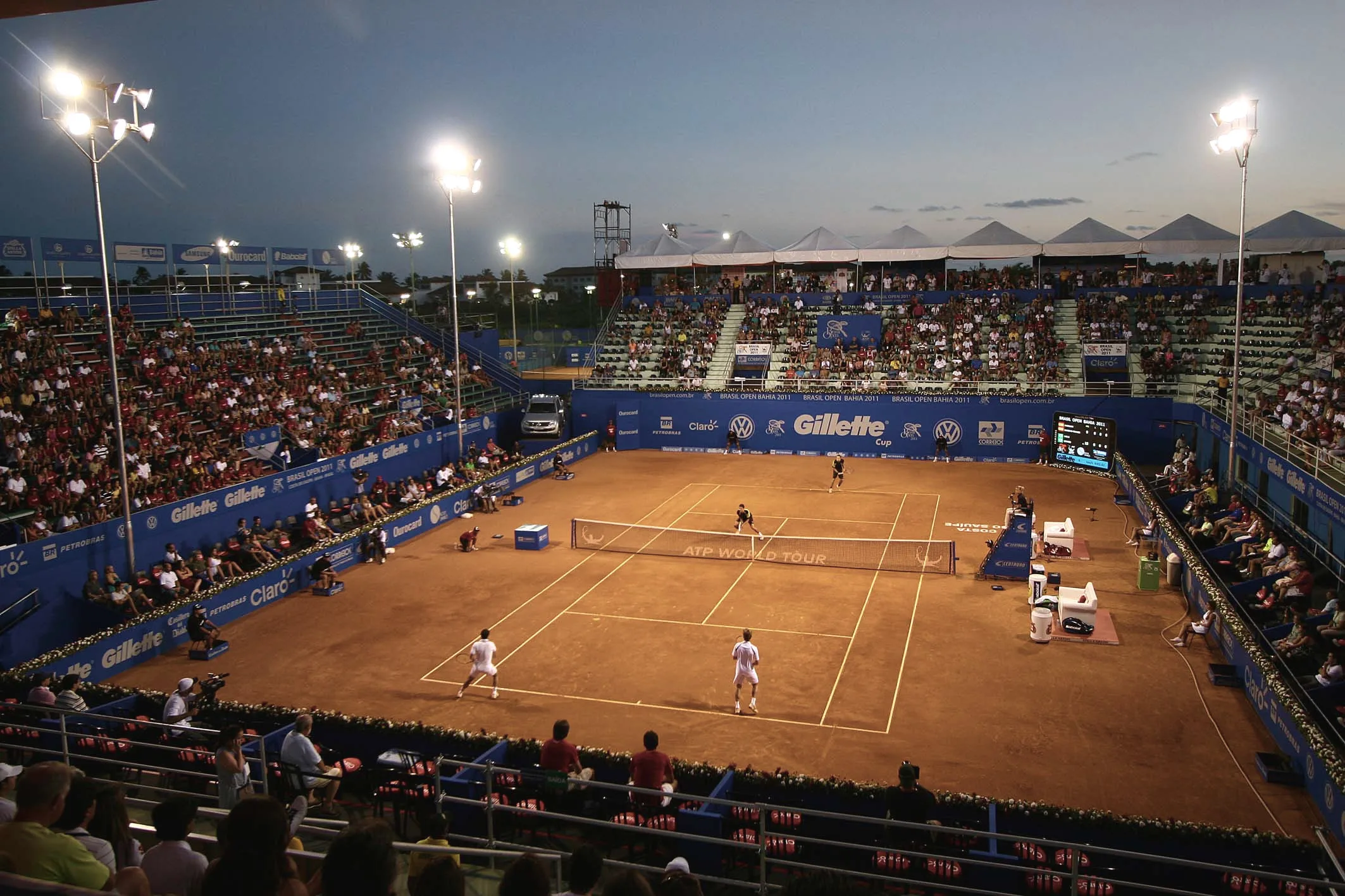
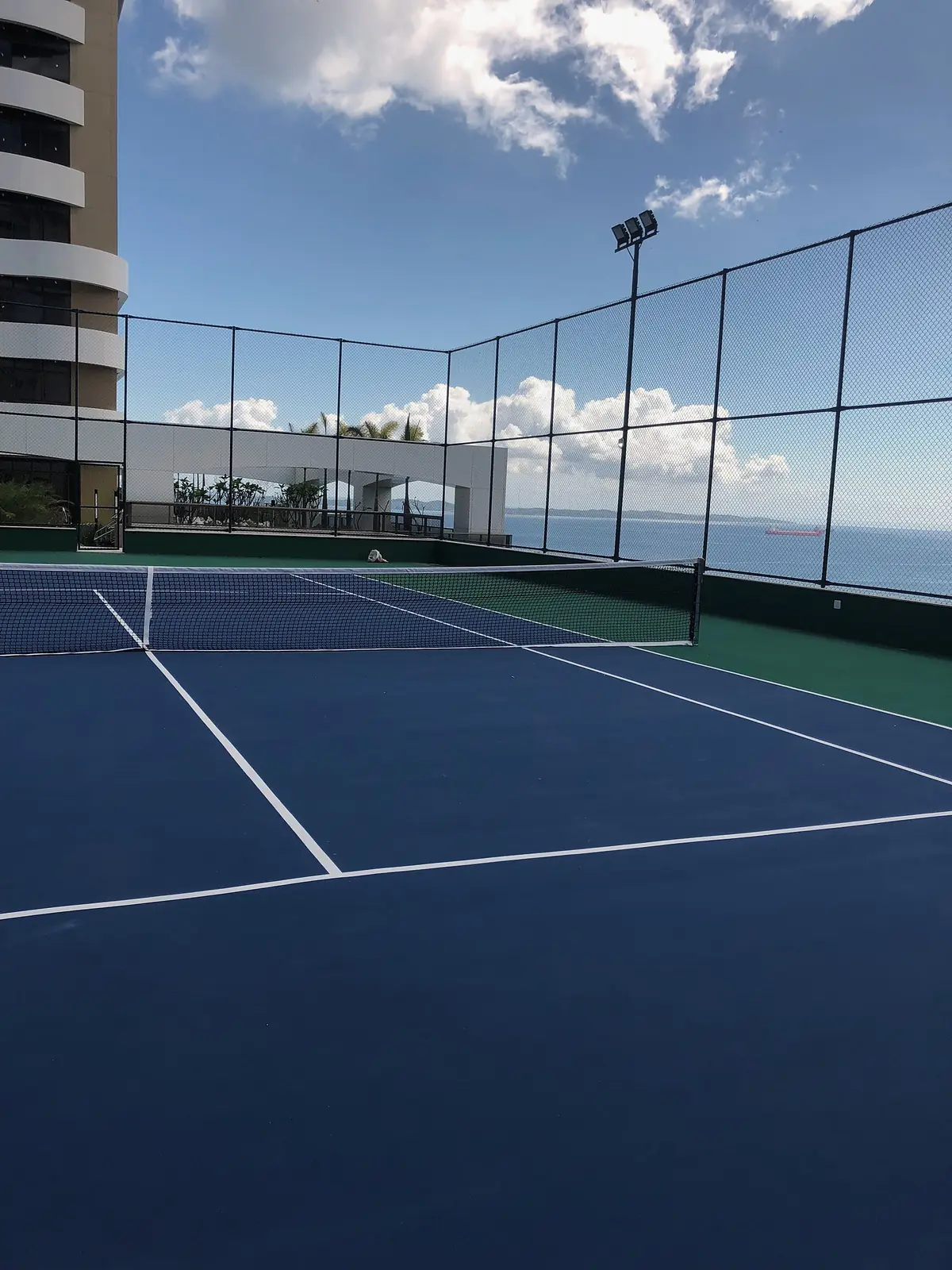
What each system is
A standard acrylic system goes directly on the asphalt or concrete. After cleaning and repairs, the court gets one or two coats of sand-filled acrylic resurfacer, then usually two or three textured color coats and the lines. The finished layer is a fraction of an inch thick, so the court is about as hard as the slab under it.
A cushioned system adds a stack of cushion coats between the resurfacer and the color. Each cushion coat is an acrylic binder filled with rubber granules, applied in a thin pass and left to dry before the next. The number of coats, which ranges from a few to more than five depending on the system, sets how much give the surface has: more coats, more cushion and more cost. The color coats on top are the same kind of textured acrylic, so the court looks and plays like a hard court.
Both systems in this guide go over an existing, sound asphalt or concrete slab during a resurfacing.
Comfort and joint load
On a standard court, the impact of each step and stop goes into the slab and back into the player. Cushion layers absorb part of that energy and spread it over a slightly longer moment, which lowers the peak load on ankles, knees, hips and lower back. Players commonly describe cushioned courts as softer and less tiring over a long session.
The effect grows with the number of cushion coats, and it is felt most by people who play often or for long sessions, and by older players with joint problems. Footing stays firm: cushioned acrylic does not slide like clay, and players move on it as on any hard court.
Ball speed and the ITF pace classification
The ITF classifies tennis surfaces by pace with a laboratory or on-site test that measures how a ball behaves on impact, expressed as a Court Pace Rating. Surfaces fall into five categories: 1 slow, 2 medium-slow, 3 medium, 4 medium-fast and 5 fast. A classification belongs to a tested product or system, not to a surface type in general.
On acrylic courts, pace is set mostly by the texture of the top coats. More sand, or coarser sand, in the color coats slows the ball; less makes it faster. Because the same color coats sit on top, a cushioned court can be made slow or fast like a standard one. Some players feel a slightly lower, softer bounce on heavily cushioned courts. If pace matters, for a club, an academy or a tournament, specify the texture and ask for the system's ITF classification in writing instead of assuming it from the word cushion.
Standard vs cushioned at a glance
- Build-up
- Standard: resurfacer and color on the slab. Cushioned: several rubber-granule cushion coats between them.
- Comfort
- Standard: about as hard as the slab. Cushioned: softer, lower impact; more coats, more give.
- Pace
- Set mainly by the texture of the color coats on both; check the ITF classification of the system specified.
- Heat
- Set mainly by sun and color on both.
- Cracks
- Reflect through both; repair is more involved on cushion.
- Recoat cycle
- Similar, commonly 4 to 8 years in Florida; sound cushion can stay at recoat.
- Cost
- Cushion adds materially, more with each coat.
- Requires
- Cushioned: a sound slab with few active cracks.
Typical industry behavior. Each manufacturer's system has its own specification.
Heat
Surface temperature on a Florida afternoon is driven mainly by sun and color. Dark colors absorb more energy and run hotter; light colors run cooler. Cushion layers sit under the color and do not make the surface cooler to the touch.
For heat, the decisions that make a measurable difference are the same on both systems: a lighter color scheme, shade at the benches, water stations and play scheduled away from the hottest hours.
Durability and crack behavior
The color coats on a cushioned court wear like those on a standard court and need renewal on a similar cycle, commonly every four to eight years in Florida depending on use and sun. When the cushion layers are still sound and bonded at that point, the next resurfacing often renews only the color coats and lines, so the cushion can carry across more than one cycle.
Cushion does not stop cracks. A crack in the slab reflects up through cushion coats just as it does through standard acrylic. Repairing it is more work: the cushion around the crack is cut back, the crack repaired, and the cushion rebuilt in layers to match the surrounding thickness before color goes on, or the repair is felt as a hard line underfoot. That is why cushion belongs on a slab with few active cracks.
- Poor candidates for cushion: asphalt with many open or recurring cracks.
- A base that is settling, or ponding across large areas.
- A court likely to need reconstruction within a few years.
- Slabs where moisture rising from below has already caused blistering.
Maintenance
Day-to-day care is the same on both: keep the court clean, clear standing water, wash on a schedule and seal new cracks early. Cleaning a cushioned court calls for moderate pressure, because a jet held too close can damage the layers under the color.
Two differences matter. Point loads show more on a cushioned surface: chair legs, ladders, ball machines with narrow wheels and rolling carts can dent it, so keep them off the court or on boards. And crack repairs cost more, as above, so catching cracks early pays back faster on a cushioned court than on a standard one.
Cost difference
Cushion adds materially to a resurfacing. Material and labor for the cushion coats are added to everything a standard resurfacing already includes, and each extra coat adds a pass and drying time to the schedule. Depending on the number of coats, the cushion portion alone can approach or exceed the cost of the standard resurfacing.
Ask for both systems as alternates in the same written scope, with the number of cushion coats stated, so the board sees the difference on one page. Compare over two cycles as well as one: if the cushion stays sound, the following resurfacing may cost close to a standard one.
Who each one suits
A practical guide, always checked against the condition of the slab:
- Standard acrylic: most HOA and condominium courts, schools, multi-sport courts, asphalt courts with a history of cracking, and any court where the budget should go first to repairs and drainage.
- Cushioned acrylic: communities with many senior players, clubs and academies with long daily sessions, and resorts that want a premium court for guests and lessons.
- Pickleball-heavy communities: players often play several games back to back, many are older, and the short, quick movements of the game load the joints. Cushion is often worth pricing as an alternate.
- Mixed properties: some cushion one or two showcase or lesson courts and keep the rest standard.